The word “tray” hides a lot of decisions. A rolled-rim paperboard tray carrying nachos across a stadium concourse has almost nothing in common with a crystallized-plastic tray that travels from a retail freezer into a 200°C oven, yet both surface when a buyer searches for food trays. Choosing well starts with the job the tray has to do, not the material on the spec sheet. This guide walks through the main use cases and the tray formats that fit each one, with the temperature and handling numbers that actually decide the match.
Start with the temperature journey, not the shape
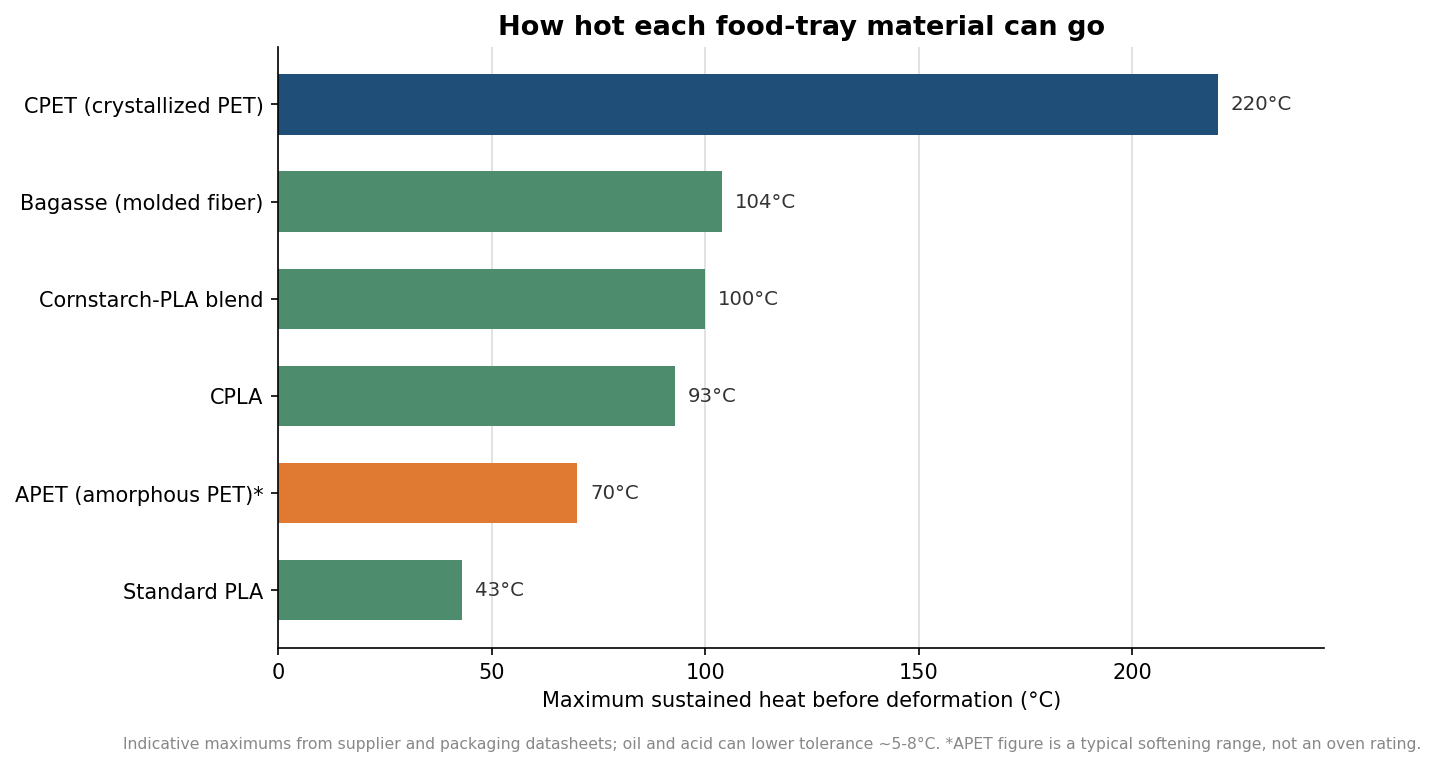
Before you compare shapes, map the hottest and coldest point the tray will ever see, and how long it sits there. That single question removes most of the options for you. Crystallized PET, or CPET, is the heat-treated form of PET built for the widest swing: suppliers rate it from roughly -40°C to +220°C (-40°F to 428°F) without deforming, which is why it dominates freezer-to-oven ready meals. Amorphous PET, or APET, is the same polymer without that crystallization step; it stays glass-clear and inexpensive but softens far below oven temperatures, so it belongs to chilled and ambient display rather than reheating. Polypropylene (PP) reheats well in a microwave and handles the freezer down to about -20°C, with specialist grades to -40°C, but it is not rated for a conventional oven at any duration. The chart below sets the practical ceiling for each common material.
Concessions and grab-and-go
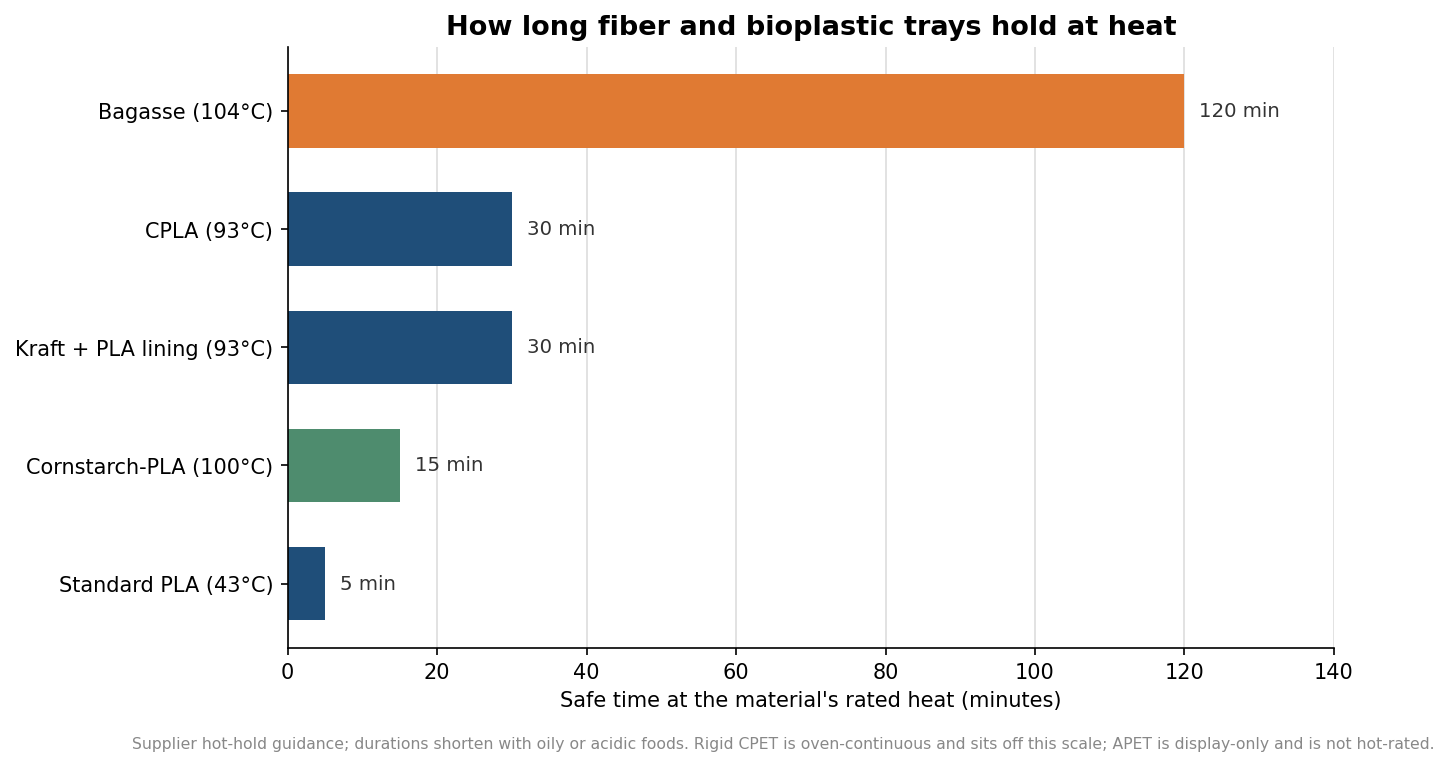
Concession service is about speed, grease resistance, and a tray that holds its shape in one hand. This is the home of rolled-rim paperboard trays and molded fiber (bagasse) formats. Bagasse is pressed from sugarcane pulp and handles hot food better than most people expect: typical datasheets rate it to around 220°F (104°C) with dry heat and about 200°F with liquids, for up to two hours. It also vents steam, which keeps fried food from steaming itself soggy in the first few minutes. Common footprints run from small one-compartment boats in the six-inch range up to three- and five-compartment platters, so the real decision here is compartment count and depth rather than exotic material properties. If the food is dry and served fast, coated paperboard is the cheaper pick; if it is hot, oily, or saucy, fiber earns its slightly higher unit cost.
Retail ready meals and meal prep
Once a tray has to survive a reheat by the end customer, the material choice tightens sharply. For anything that will be finished in an oven, CPET is effectively the only rigid option, because it moves from freezer to oven without warping and takes a heat-seal film cleanly for a gas-tight pack. Where the customer will only ever use a microwave, PP is the more economical answer: it yields more trays per tonne of resin, seals well, and reheats fine, as long as nobody expects it to bake. Meal-prep brands that sell chilled, microwave-only bowls almost always land on PP for cost, while frozen bake-at-home lines land on CPET for the oven step. Whichever you pick, the sealing surface and rim geometry matter as much as the polymer, since a tray that will not take a clean film seal leaks regardless of how heat-resistant it is.
Catering, display, and reusables
Catering and buffet service push the decision toward size, rigidity, and reuse rather than reheating. Large display platters are usually shallow, wide, and lidless, chosen for how the food looks rather than how it travels. Nesting reusable PP trays suit closed-loop operations such as canteens and meal delivery services that get their trays back, where a heavier-gauge tray amortizes across dozens of wash cycles. Compartment meal trays sit in the middle, keeping a protein and two sides separate on a single carried unit. The buying question here is less about temperature and more about stacking, nesting depth, and whether the tray has to endure a commercial dishwasher, which quietly rules out most single-use materials.
The compostable route and its limits
If a compostable claim matters to your buyers, understand where fiber and bioplastics genuinely perform and where they quietly fail. Bagasse is the workhorse of certified-compostable hot-food service and typically carries ASTM D6400 (via BPI certification in the United States) and EN 13432 in Europe. Bioplastics are less forgiving. Standard PLA has a glass transition around 110-115°F, so it deforms under genuinely hot food; heat-treated CPLA pushes that to roughly 200°F for about half an hour and is the better pick for warm service, at a cost premium of around thirty percent over standard PLA. Across all of these, oil and acid pull the safe temperature down by roughly 10-15°F versus a plain-water rating, so a compostable tray that passed a lab test on soup may still slump under a hot, oily curry. The duration chart below shows how quickly the softer materials fall away once heat is involved.
The reliable way to choose is to run the tray through three filters in order: the temperature journey first, the sealing and handling demands second, and cost or sustainability last. If the food gets baked, you are on CPET or fiber. If it only gets microwaved, PP saves money. If it is served fast and never reheated, coated paperboard or bagasse is plenty, and the choice collapses to compartment count and depth. Sustainability claims are worth making only when the material actually survives the service temperature, which is why bagasse and CPLA show up on hot lines while standard PLA stays on cold ones. Match the format to the journey and the rest of the specification tends to fall into place. Where a figure here is described as indicative, treat it as a starting point and confirm against the specific supplier datasheet for the exact tray and food you are packing.